
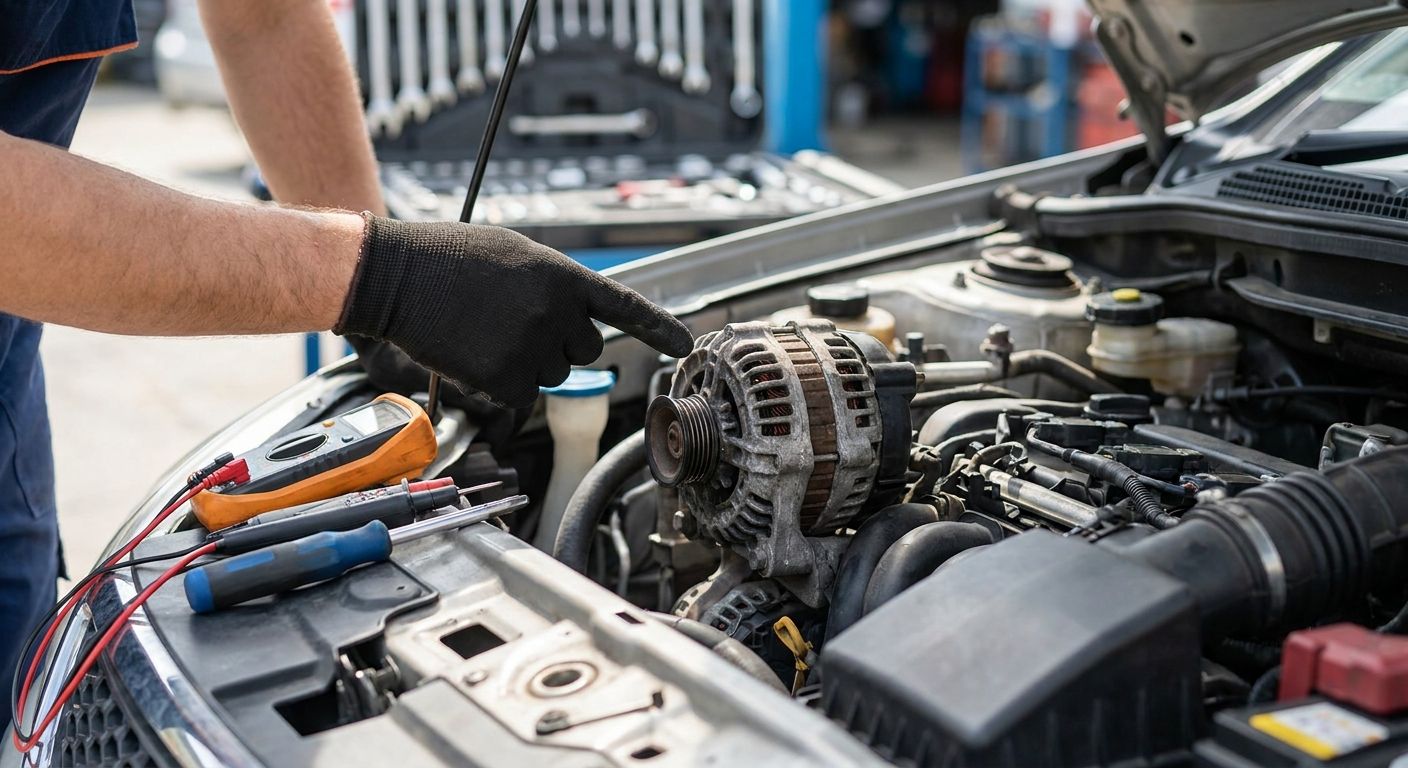
A weak or failing alternator shows up as dim headlights, a battery warning light, or a car that won't start after sitting overnight, and knowing the difference between an alternator problem and a battery problem saves you an unnecessary part swap.
- A dashboard battery light while driving points to the alternator, not the battery itself.
- A healthy alternator puts out 13.5 to 14.5 volts with the engine running.
- Dimming or flickering headlights at idle is one of the clearest signs you need a new alternator.
- A battery that dies again a day after a jump usually means the alternator isn't recharging it.
- TRC Automotive tests the alternator, battery, and belt together before replacing anything.
Why this matters
A failing alternator doesn't just leave you stranded. It can drain a good battery, starve your electrical system mid-drive, and in some cases stall the engine on the road.
Catching the signs early means a planned repair instead of a tow truck. Most drivers wait until the car won't start, but the alternator usually gives warning signs for days or weeks before it quits.
At TRC Automotive, the charging system gets tested, not guessed at. That matters because a bad battery and a bad alternator look nearly identical from the driver's seat.
What you'll need
- A digital multimeter, if you want to check voltage yourself
- 15 minutes with the hood open, engine off and then running
- A flashlight to check the battery terminals for corrosion
- Your owner's manual, to confirm the normal charging voltage for your vehicle
- A shop visit if you don't own a multimeter or don't want to guess
The steps
1. Watch the dashboard warning lights
The battery-shaped light on your dash is the first clue, and it almost always means a charging system issue rather than a dead battery. It comes on when the alternator isn't producing enough voltage to run the electrical system.
Start the car and watch the dash for 10 seconds. If that light stays on while you drive, the alternator is failing right now. Waiting more than a day or two often ends in a stall.
Common mistake: assuming the battery light means the battery is bad. A new battery fixes nothing if the alternator is the real problem.
2. Check your headlights at idle
With the engine running and the headlights on, rev the engine gently and watch the brightness. Headlights that dim at idle and brighten when you press the gas are a textbook alternator symptom.
This happens because a weak alternator can't keep up with electrical demand at low RPM, so the system pulls extra power from the battery until engine speed rises.
Expected outcome: steady brightness at any RPM means the charging system is likely healthy.
3. Test the battery voltage at rest
With the engine off, touch the multimeter red lead to the positive terminal and the black lead to the negative terminal. A healthy, fully charged battery reads about 12.6 volts at rest.
If it reads under 12.4 volts, charge it fully before moving on. A low starting voltage will throw off the alternator test in the next step.
4. Test alternator output with the engine running
Start the engine and take the same reading at the battery terminals. A working alternator shows 13.5 to 14.5 volts with the engine running and no major accessories on.
Now turn on the headlights, blower motor, and rear defroster and check again. The reading should not fall much below 13 volts. If it sits at 12.6 volts or lower with the engine running, the alternator is not charging the battery, and that is your answer.
Common mistake: testing right after a jump start. Let the engine idle at least 5 minutes first so the reading reflects real alternator output.
5. Listen for a grinding or whining noise
A failing alternator often makes a growling or whining sound tied to engine RPM, coming from the front of the engine where the belt drives it. That usually means worn bearings inside the alternator.
Open the hood with the engine running and listen near the belt. A noise that rises and falls with engine speed, separate from a squealing belt, points at the alternator bearings.
6. Check whether the battery holds a charge
If your car needed a jump and then died again the same day or the next morning, the battery is probably not the root cause. A good battery holds a charge for days when the car sits. A bad alternator drains it over and over because it never fully recharges while you drive.
Expected outcome: a jump that only lasts a few hours means the alternator gets tested before you buy a battery.
7. Watch for electrical accessories acting up
Slow power windows, a flickering dashboard, a radio that cuts out, or interior lights that dim when you brake all point to inconsistent voltage. These symptoms usually show up together, not one at a time.
If you notice two or more on the same drive, the charging system needs a proper test rather than a guess at which part is failing.
8. Get a diagnostic before replacing parts
A real diagnostic checks alternator output under load, the battery's state of health, and the belt, wiring, and grounds. A loose belt or a bad ground can mimic alternator failure without the alternator being bad at all.
Every visit at TRC Automotive includes a scored report card with photos, so you see what tested weak and why before any part gets replaced. That is dealer-level service without the dealership.
Get your charging system checked
Alternator, battery, and belt tested together, with a scored report card and photos.
Troubleshooting
- Battery light flickers on and off. This often means a loose or corroded connection at the alternator plug rather than full failure. Have the connector and grounds checked first.
- Car starts fine but dies while driving. That points to the alternator failing under load, not a starting problem. Get it tested the same day, because it can leave you stranded without warning.
- New battery, same symptoms. The battery was never the problem. The alternator is still failing to charge, and it will drain the new battery too.
- Belt squeals but voltage tests fine. A slipping or worn serpentine belt can starve the alternator of the speed it needs. Replace the belt before you replace the alternator.
- Voltage reads above 15 volts. An overcharging alternator is as much a problem as a weak one and can ruin a battery early. It needs the same diagnostic attention as low voltage.
- Lights dim only when the AC or heater runs. That is a sign the alternator cannot keep up with electrical load, common on vehicles past 100,000 miles on the original unit.
Tools and resources
- A digital multimeter for at-home voltage checks at the battery terminals
- Your owner's manual, for the manufacturer's normal charging voltage range
- A load test on the battery, which separates a worn battery from a weak alternator
- A full charging system diagnostic at TRC Automotive, covering alternator, battery, belt, and wiring together
What to do next
If even one of these signs matches what your car is doing, do not wait for it to get worse. Alternators generally last 80,000 to 150,000 miles depending on the vehicle and electrical load, and once one starts to fail it usually gets worse in days, not months.
Get the charging system tested before you spend money on a battery that is not the problem. TRC Automotive uses OEM or better parts and stands behind qualifying work with a 36 month, 36,000 mile warranty across the lower 48. That is how we do it right the first time for neighbors in Belmont, Mount Holly, McAdenville, and Cramerton in 2026.
FAQ
How do I know if it's the alternator or the battery?
A battery warning light that stays on while you drive points to the alternator, while a battery that simply will not hold a charge overnight points to the battery. A multimeter reading under 13.5 volts with the engine running confirms the alternator is not charging.
What are the signs you need a new alternator?
Dimming headlights at idle, a lit battery warning light, a growling noise from the engine bay, and a battery that dies again after a jump are the main signs. Sluggish or flickering electrical accessories often show up at the same time.
Can a car run with a bad alternator?
A car runs for a short time on battery power alone after the alternator fails, then stalls once the battery drains. It will not restart until the alternator is replaced or the battery is recharged.
How much does it cost to replace an alternator in 2026?
Alternator replacement cost depends on your vehicle, since parts and labor vary widely by engine and layout. A shop can give you an exact number in 2026 after testing the charging system and confirming the alternator is the failed part.
How long does an alternator usually last?
Most alternators last 80,000 to 150,000 miles under normal driving. Heavy electrical loads, lots of short trips, and extreme heat shorten that lifespan.
Can I test my alternator myself?
Yes. A digital multimeter at the battery terminals with the engine running should read 13.5 to 14.5 volts. A shop diagnostic goes further by testing output under electrical load and checking the belt, wiring, and grounds.
Will a new battery fix alternator problems?
No. A new battery will drain on the same schedule if the alternator is not charging it. The alternator has to be tested and replaced if the output is low.
Is it safe to keep driving with a bad alternator?
Driving with a failing alternator risks a sudden stall, because the car is running on battery power alone. Power steering and power brakes weaken as voltage drops, so it is a safety issue and not just an inconvenience.
One last thing
Most drivers replace the battery first because it is the cheaper guess, and that is the number one reason people are back a week later still stranded. Test the charging system first. It takes 15 minutes and tells you which part is actually failing before you spend money on the wrong one.