
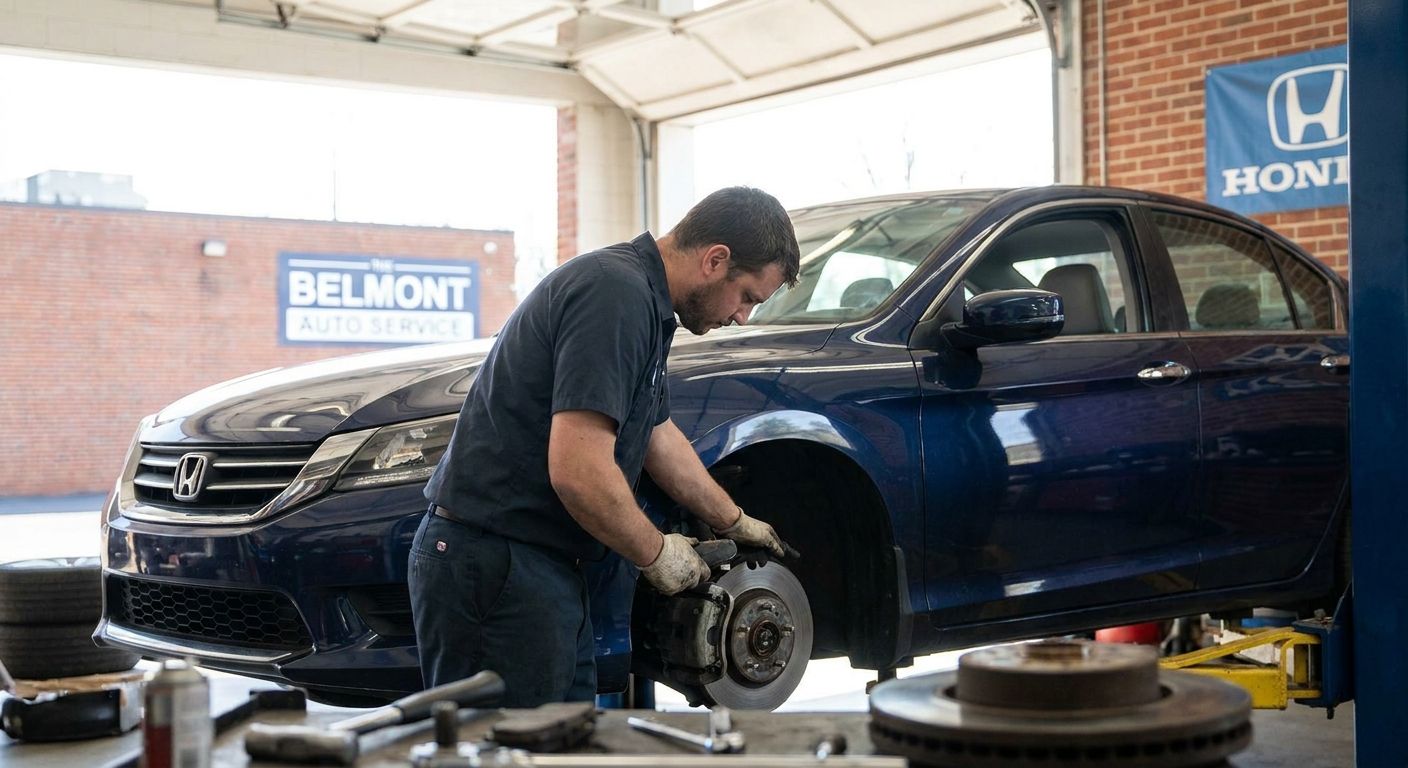
If you drive a Honda in Belmont, Mount Holly, McAdenville, or Cramerton, this guide breaks down what your brakes actually need, what a fair repair looks like, and when it's time to schedule service instead of waiting.
- Front brake pads on most Hondas wear out between 25,000 and 45,000 miles in mixed city driving.
- Squealing, pulsing, or a soft pedal means schedule honda brake repair in Belmont, NC now, not next month.
- TRC Automotive uses OEM or better parts and backs qualifying brake work with a 36 month, 36,000 mile warranty.
- Skip cheap aftermarket pads on a Civic or CR-V; they wear faster and can grind sooner than factory-spec parts.
- A scored report card with photos tells you exactly what your Accord or Pilot needs before you approve any work.
Why this matters
Honda brakes are built to be predictable, but predictable doesn't mean maintenance-free. A Civic, Accord, CR-V, or Pilot that sits in Charlotte-area traffic wears its front pads faster than the same car on open highway. Waiting past the warning signs turns a pad job into a rotor job, and a rotor job into a caliper job. Knowing what to look for keeps a small brake repair small.
Who this is for
This guide is for maintenance-minded Honda owners in Belmont and the surrounding towns who follow the manufacturer's schedule and want their car handled right the first time. If you drive a Civic, Accord, CR-V, Pilot, or Odyssey and you've noticed a squeal, a pulse in the pedal, or a dash light, this is written for you. It's also for anyone comparing dealer-level service without the dealership markup on a routine brake job.
What to look for in honda brake repair
OEM or better parts
Honda pads and rotors are engineered to match the weight and stopping distance of your specific model. A shop that installs OEM or better parts keeps that engineering intact instead of swapping in a generic pad that wears unevenly or squeals within a few months.
ASE-certified diagnostic work
A pulsing pedal isn't always a warped rotor, and a squeal isn't always worn pads. An ASE-certified technician checks caliper slide pins, brake fluid condition, and hardware before recommending a repair, so you're not paying for parts you don't need.
A scored report card with photos
You shouldn't have to take anyone's word for pad thickness or rotor condition. A report card with photos shows you the actual wear on your Accord or CR-V, so you can see what's urgent and what can wait.
Warranty coverage on the repair
Brake work that only lasts a year isn't a deal. A 36 month, 36,000 mile warranty on qualifying work means the shop stands behind the parts and the labor, not just the invoice.
Local convenience for Belmont-area driving
Stop-and-go driving through Belmont, Mount Holly, and Cramerton wears brakes faster than highway commuting. A shop close to home makes it easier to catch a squeal early instead of driving across Charlotte for a diagnostic.
Common honda brake jobs and what they need
The routine one: front pad and rotor replacement. Front pads on a Civic or Accord typically wear down between 25,000 and 45,000 miles depending on how much city driving you do. If you're hearing a metallic squeal at low speed, this is likely it. Schedule now.
The one people put off: rear brake service. Rear pads last longer than fronts, often well past 40,000 miles, but rear calipers on CR-Vs and Pilots can stick from corrosion if they're not serviced. A dragging or uneven wear pattern means the calipers need attention, not just new pads. Schedule now.
The one that gets skipped: brake fluid flush. Brake fluid absorbs moisture over time, and most manufacturers, Honda included, recommend a fluid change every 2 to 3 years regardless of mileage. Old fluid feels spongy under the pedal and corrodes brake lines from the inside. Schedule within the next service visit.
The one that looks fine but isn't: pulsing pedal. A pedal that pulses under braking usually means a warped rotor, and resurfacing only works if there's enough material left. On many Hondas, once a rotor is under spec it needs replacement, not a resurface. Schedule now, don't wait for it to get worse.
The one you can watch: light squeal with no pull or vibration. Some pad compounds squeal slightly when cold and quiet down once warm. If there's no pulling, no grinding, and no vibration, this can be monitored at your next scheduled maintenance. Monitor, not urgent.
If your dash also shows a battery or charging warning alongside brake concerns, it's worth ruling out an unrelated electrical issue before you assume it's brake-related. This guide on how to tell if you need a new alternator walks through the warning signs.
Get your brakes checked right
See what your Honda's brakes actually need with a scored report card.
What to avoid
- Cheap aftermarket pads that look identical to OEM. They often use a harder compound that squeals sooner and wears rotors faster, costing more over the life of the car.
- Skipping the fluid flush because the pedal still feels fine. Moisture in the fluid corrodes internal components long before you feel a difference in the pedal.
- Assuming a resurfaced rotor fixes every pulse. If the rotor is already thin, resurfacing removes material it doesn't have to spare and the pulse comes back within months.
Verdict comparison
| Symptom | Likely cause | Verdict |
|---|---|---|
| Squeal at low speed | Worn front pads | Schedule now |
| Dragging or uneven rear wear | Sticking rear caliper | Schedule now |
| Spongy or soft pedal | Old brake fluid | Schedule at next visit |
| Pulsing under braking | Warped or thin rotor | Schedule now |
| Light squeal, no pull or grind | Pad compound noise | Monitor |
FAQ
How much does honda brake repair cost in Belmont, NC?
Cost depends on whether it's a pad-only job, a pad and rotor job, or a caliper replacement, and pricing varies by parts used. A shop using OEM or better parts will quote higher than one using generic aftermarket pads, but the repair lasts longer.
How often do Honda brake pads need to be replaced?
Front pads on most Hondas last between 25,000 and 45,000 miles in mixed city and highway driving. Heavy stop-and-go driving in areas like Belmont and Charlotte wears them faster than highway commuting.
Is it safe to drive a Honda with squeaky brakes?
A light squeal alone usually isn't an emergency, but it's a signal to get the pads checked soon. If the squeal turns into grinding, that means the pads are gone and the rotors are at risk, and you should schedule service right away.
Do I need OEM parts for Honda brake repair?
Honda brakes are engineered around OEM specifications for weight and stopping distance, so OEM or better parts keep that performance intact. Generic aftermarket pads can work but often wear faster and squeal sooner.
How long does a brake fluid flush last on a Honda?
Most manufacturers, including Honda, recommend a brake fluid change every 2 to 3 years regardless of mileage. Fluid absorbs moisture over time, which can corrode brake lines from the inside if it's never changed.
What's the difference between a brake inspection and brake repair?
An inspection checks pad thickness, rotor condition, and fluid quality without replacing anything. Repair is the actual replacement of pads, rotors, calipers, or fluid based on what the inspection finds.
Should I go to the dealership or a local shop for Honda brake repair?
A local shop using OEM or better parts and ASE-certified technicians can deliver dealer-level service without the dealership markup. The key is checking whether the shop backs its work with a warranty.
Why does my Honda pull to one side when braking?
Pulling under braking usually means a sticking caliper on one side or uneven pad wear between the two front wheels. This needs a diagnostic soon since it affects how the car handles under hard braking.
One last thing
The detail most Honda owners miss: a rotor that's just above minimum thickness today can be under spec by your next oil change if you keep driving on worn pads. Getting the pads replaced a few thousand miles early is almost always cheaper than replacing pads and rotors together later. TRC Automotive has been doing honda brake repair and general auto repair in Belmont since 2011, and every brake job comes with a scored report card with photos so you see exactly what's happening before anything gets replaced.