
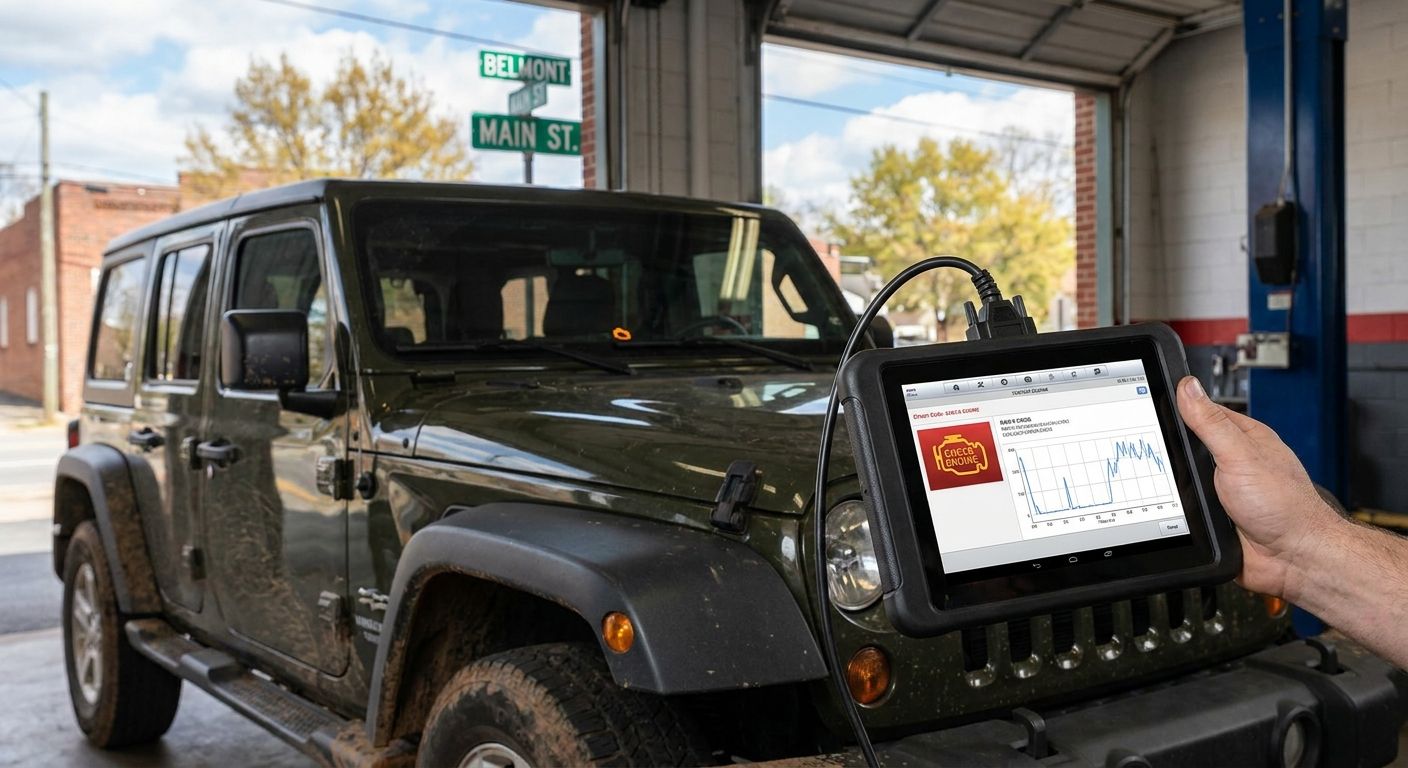
When the check engine light comes on in your Jeep, you need to know if it's a loose gas cap or a real problem before it turns into a bigger repair. This guide walks Belmont, NC Jeep owners through what triggers the light most often, what a real diagnostic looks like, and when to bring the vehicle in.
- A gas cap or EVAP leak is the most common trigger for jeep check engine light problems in Belmont NC and often costs nothing to fix.
- A flashing check engine light means an active misfire. Stop driving and get it scanned the same day.
- P0420 catalytic converter codes are frequently an oxygen sensor problem in disguise. Confirm before replacing the converter.
- TRC Automotive in Belmont reads and diagnoses Jeep-specific codes, not just generic OBD-II readouts, then backs the repair with a 36 month, 36,000 mile warranty.
“A check engine light does not tell you what is wrong. It tells you where to look.”
Why this matters
A check engine light on a Jeep Wrangler, Grand Cherokee, Cherokee, or Compass can mean a $3 gas cap or a $600 sensor. The light itself gives you a code, not an answer. Guessing wrong means you pay for a part that was never the problem, and the light comes right back on.
In 2026, Jeep owners around Belmont, Mount Holly, McAdenville, and Cramerton still bring in vehicles with the same handful of triggers year after year. Knowing which ones matter and which ones can wait saves you money and keeps you from driving on something that's actually urgent.
Who this is for
This guide is for Jeep owners in Belmont, NC who follow their maintenance schedule, want a straight answer instead of a guess, and don't want to pay a dealership markup for diagnostic work that a local shop can do just as well. If your check engine light came on this week and you're deciding whether to drive to work tomorrow, this is written for you.
Schedule a diagnostic visit through TRC Automotive before the light turns from a warning into a bigger repair bill.
What to look for in Jeep check engine light diagnostics
Jeep-specific code knowledge
A generic auto parts store scanner reads a code and hands you a printout. Jeeps, especially Wranglers and Grand Cherokees with the Pentastar V6, throw codes that need a technician who knows the platform, not just a reader that spits out a five-digit number. Ask whether the shop pulls freeze-frame data and live sensor readings, not just the stored code.
Actual repair, not code clearing
Some shops clear the code and send you home. The light comes back in days because nothing was fixed. A real diagnostic traces the code to its root cause and repairs that, not just the symptom.
OEM or better parts
Jeep sensors, coils, and modules vary by trim and model year. A shop using OEM or better parts gets the fit and calibration right the first time, which matters more on a Jeep than on a lot of other vehicles because of how tightly the powertrain control module reads sensor data.
A written report with photos
You should get more than a verbal "it's the O2 sensor." A scored report card with photos shows you exactly what was found and why it matters, so you're not taking anyone's word for it.
A warranty on the fix
If the diagnosis is wrong or the part fails early, you shouldn't pay twice. Look for a shop that stands behind the repair, ideally with a 36 month, 36,000 mile warranty that covers you across the lower 48, not just around Belmont.
Common check engine light triggers on Jeeps
The cheap one: loose or failing gas cap
A gas cap that's loose, cracked, or missing its seal triggers an EVAP system code, usually in the P0440 to P0457 range. This is the single most common reason a Jeep's check engine light comes on, and it costs nothing if the cap just needs tightening.
Verdict: check first. Tighten the cap until it clicks 3 times, then drive normally. If the light doesn't clear within a day or two of driving cycles, get it scanned.
The mileage tax: oxygen sensor failure
Oxygen sensors wear out with age and mileage, and a failing one shows up as reduced fuel economy along with the check engine light. Left alone long enough, a bad O2 sensor can damage the catalytic converter, turning a moderate repair into an expensive one.
Verdict: get it in soon. Don't wait months on this one. The longer it runs rich or lean, the more it costs you at the pump and the more it risks the converter.
The rough idle: ignition coil or misfire codes
Codes in the P0300 to P0308 range point to a misfire, often an ignition coil or spark plug on Jeep V6 and V8 engines. You'll usually feel it as a rough idle or a hesitation under acceleration before the light ever comes on.
Verdict: don't drive on it long. A misfire that continues can dump unburned fuel into the exhaust system and damage the catalytic converter within days, not months.
The expensive one: catalytic converter code
P0420 means the catalytic converter efficiency is below threshold, and a lot of shops jump straight to replacing the converter. In many cases the real cause is a failing oxygen sensor sending bad data, not a dead converter.
Verdict: confirm before you replace. A proper diagnostic checks sensor readings before anyone quotes converter replacement, which can save you hundreds of dollars.
The shifter surprise: transmission solenoid codes
Older Jeep automatics, especially Grand Cherokees and Cherokees with higher mileage, sometimes throw transmission solenoid or torque converter clutch codes. You might notice a harsh shift or a slight shudder before the light appears.
Verdict: get it checked before a road trip. This one rarely strands you overnight, but it can turn into a bigger transmission repair if the fluid and filter haven't been serviced in a while.
What to avoid
- Clear-and-drive services. Some quick-lube style shops will clear a code for a flat fee without diagnosing anything. The light comes back within a week and you're out the money.
- Guessing at the catalytic converter. Replacing a converter based on a P0420 code alone, without checking the oxygen sensors first, is one of the most common overcharges on Jeeps.
- Ignoring a flashing light. A steady check engine light means get it checked soon. A flashing one means an active misfire that can damage the catalytic converter in a matter of miles. Don't keep driving on a flashing light.
Get your check engine light diagnosed right
Local, ASE-certified diagnostics for Jeep owners in Belmont, NC.
Verdict comparison across common triggers
| Trigger | Typical cause | Urgency | Verdict |
|---|---|---|---|
| EVAP / gas cap code | Loose or worn gas cap seal | Low | Check first |
| Oxygen sensor code | Worn sensor, reduced fuel economy | Medium | Get it in soon |
| Misfire (P0300-P0308) | Ignition coil or spark plug | High | Don't drive on it long |
| P0420 converter code | Often a sensor issue, not the converter | Medium | Confirm before you replace |
| Transmission solenoid code | Fluid condition, solenoid wear | Medium | Get checked before a trip |
FAQ
What does a check engine light mean on a Jeep?
It means the powertrain control module has detected a reading outside normal range, most often in the emissions, fuel, or ignition system. The light itself doesn't identify the part, only the code, and a technician still has to trace it to the actual cause.
Is it safe to drive a Jeep with the check engine light on?
If the light is steady, you can usually drive short distances to get it checked, but don't put it off for weeks. If the light is flashing, stop driving and have it towed or scanned immediately, since that signals an active misfire.
Why does my Jeep's check engine light flash instead of stay on?
A flashing light means the engine is misfiring badly enough that raw fuel could be reaching the catalytic converter, which can cause overheating and permanent damage. This is one of the few check engine light situations that needs attention the same day.
How much does check engine light diagnostics cost in Belmont, NC?
Pricing depends on the vehicle and what the code points to, so check current pricing directly with the shop before your visit. A proper diagnostic includes pulling live data and freeze-frame information, not just reading a code.
Can a loose gas cap really trigger the check engine light?
Yes, a loose, cracked, or missing gas cap seal is one of the most common reasons a Jeep's check engine light comes on. Tighten the cap and give it a couple of driving cycles before assuming it's something bigger.
Do I need to go to a Jeep dealership for check engine light diagnostics?
No, a local shop with ASE-certified technicians and Jeep-specific diagnostic tools can perform the same level of diagnostic work as a dealership, often without the dealership markup. What matters is whether the shop diagnoses the root cause instead of just clearing the code.
How long does a check engine light diagnosis take?
Most diagnostics can be completed the same day, though the exact time depends on how many codes are stored and how much testing is needed to confirm the cause. Complex intermittent issues sometimes require a test drive to reproduce the fault.
What's the difference between reading a code and diagnosing it?
Reading a code just tells you which system triggered the light. Diagnosing it means testing the actual components, sensors, and wiring tied to that code to confirm the real cause before any part gets replaced.
One last thing
Here's the part most people never hear: a P0420 catalytic converter code is, more often than not, actually an oxygen sensor telling the computer bad information, not a dead converter. Replacing the converter first is the single most common overcharge tied to a Jeep check engine light. Ask for the sensor readings before you approve that repair.
If your Jeep's check engine light came on because of an electrical issue rather than an emissions code, it's worth ruling out a failing alternator too, since a weak charging system can throw its own set of codes. Here's how to tell if you need a new alternator before you assume the worst about your engine.
TRC Automotive has served Belmont, Mount Holly, McAdenville, and Cramerton since 2011, and every check engine light visit gets a scored report card with photos so you know exactly what's going on under the hood. That's dealer-level service without the dealership, backed by a 36 month, 36,000 mile warranty when the repair qualifies.